
Stoops the Osprey was rehabilitated by Steve and Angela Hicks with Bubba and Friends, Inc. in Zebulon. Bubba and Friends, Inc. is a non-profit organization that receives NO state or federal funding. Information to send your donations is below. Check in with The Pike County Times.com for updates on raptors that are being rehabilitated by Bubba and Friends, Inc. Contact information is below if you would like to schedule an education program for a special occasion.
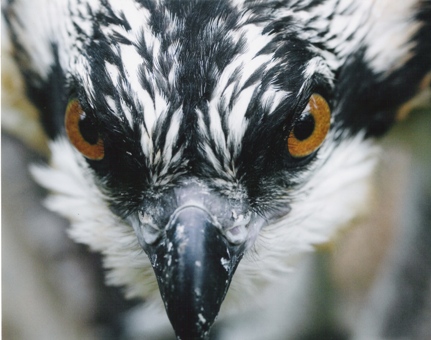
After weeks of planning, implementing, improvising, and non-stop research we reached an important agreement with Stoops. She developed a dislike for her caregivers, even flying to the opposite side of her flight pen when we entered the enclosure. (These are the same folks she screamed at for weeks earlier when she wanted to be fed.) She adapted quickly to developing and refining her fishing skills, consuming fish from her pond as fast as we could catch them and put them in there for her. Since she obviously did not need us anymore it was time for her to go home, back into the world she belongs to. After serious discussion among the members of the release team, the decision was unanimous.
On a bright October 2nd morning she was moved, with much flapdoodle on her part, to a large perch overlooking a big pond. As soon as she was placed on the perch she faced into the wind and was airborne. There was no hesitation in her flight. Her six-foot wingspan allowed her to lumber into a fall sky. Within a couple minutes of taking flight she was headed due south and never looked back. Months of intense effort and work culminated with a great release but left us missing her. I wish she would call and let us know... oh well.
Special thanks to Grand Young'uns Bait Shop in Concord for having the best minnows around and to Paul Powers for his fantastic pictures.
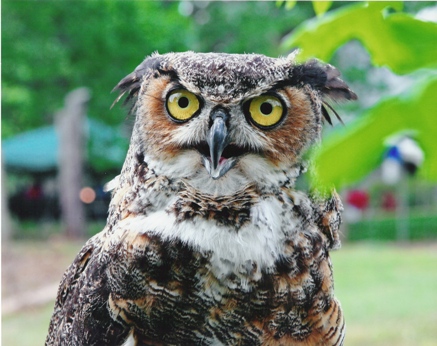
Al, our resident Great Horned Owl, has reached a new landmark this year. He could care less.
Al was a mature adult GHO when he came to us about 10 years ago. Some folks found him in Molena, Ga. with a completely destroyed left shoulder. Dr. Margo Wirth, DVM was so impressed with his disposition and temperament she developed a technique to save him. The shoulder was debrided of fractured bone and overlapping the muscles and suturing them created an artificial joint. Al could never return to the wild but he could fly in a flight pen.
Orphan GHO are very susceptible to imprinting. Imprinting is a behavior that occurs from excessive exposure to people. The GHO grows up believing that they are people and people will feed them. As the owl reaches sexual maturity their behavior becomes aggressive toward people. When a GHO becomes imprinted it must be euthanized. All the owls in Georgia are susceptible to imprinting with the same consequences. It is illegal to keep owls for pets.
Al is extremely tolerant of baby GHO’s flying around in his flight pen. He is on an “owl schedule” not a people schedule. The orphans watch him fly down and get food. Soon his expert role modeling is mimicked by the young and they begin acting like a GHO. This has been a routine in his flight pen for the last 8 years.
This fall we will release 3 former orphans into the wild. This will be Al’s 38, 39, and 40th foster owls. He has turned into an incredible surrogate parent. While we are excited about this landmark, Al really could care less.
GHO’s can live 30 years in captivity. Al is around 12-14 years old this year. During his days off from surrogate parenting Al is featured in our educational programs.
Good job Al!!
It’s time to get your owl boxes ready to go up. When the other birds migrate for the winter, owls use the abandoned sites for their nest. Great Horned Owls nest in Red Tail Hawk or Bald Eagle nests, they do not use cavities. The Screech Owl, Barred Owl, and Barn Owl are cavity nesting birds and readily adapt to man-made boxes. The boxes should be put up in November and December. Boxes can be made from scrap wood that is not pressure treated.
Owls are great for rodent control. They are fond of mice, rats, chipmunks, snakes, lizards and insects.
We have a received a number of phone calls from folks who want to know why they can’t visit with the raptors here.
The hawks, owls, falcons, vultures, and eagles here are wild birds that are injured or orphaned. The key word is wild. Our goal is to get them back into the wild as quickly as possible. Visitors can stress them out, or worse the raptors may lose their fear of people. We operate with permits/licenses from the Georgia DNR and the US Fish and Wildlife Service. The regulations both agencies use ”prohibit public access to wildlife in rehabilitation”.
Our education birds are housed among the rehab birds so access to them is restricted because of the regulation. Our ed birds go out to programs since the public can’t come in. We have been working on procuring a larger tract of land so there is enough room for visitors and a separate rehab area. We are also working on raising enough money to get a new computer and cameras to let folks view rehab and release from their computers.
Please don’t take offense when you ask to see the birds and we say no. It’s not personal.
P0 Box 103
Zebulon, GA 30295
Week One
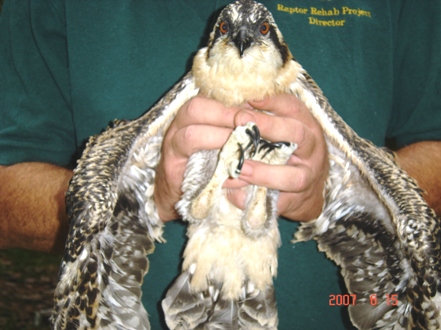
Week Two
Stoops has done it!!! She has successfully captured a live fish from her pond. This is being repeated daily.
The success of this behavior is exciting because she did not have an adult role model. We were extremely concerned about her ability to hunt for herself. She is very graceful, in her immature ways, when catching her dinner. Hey, maybe we can enter her in a Tournament!!
The second big obstacle has also been overcome. There was great concern about her developing a dependent relationship with people. This condition is know as imprinting and usually results in euthanasia. Imprinted wildlife do not recognize their own species.
They think they are people. When sexual maturity occurs they view people as mates and competition for mates. This can result in serious injury to the people and/or their children. Stoops now flies away from anyone entering her flight pen. She is also quick to defend her dinner.
Stoops next big event will be release into the wild. Fall is coming on and and the weather may cool down quickly (or not- who knows). She needs to be hunting on her own before the weather turns cold.
We are not watching for stable weather pattern, about a week long, to release her on the Flint River.
More to follow........
Miss Stoops has been moved to a large, open air flight pen at an undisclosed location. We constructed a small pond in her new home and are placing live fish in it for her. She is progressing slowly. She watches the fish swimming, but is hesitant to go after them. On Sat Aug 18 she caught and ate an 8" long bass. Hooray!!!
In warm weather raptor appetites are slow. They don't eat as much as they do in cool weather. This the perfect time for our student osprey to spent hours watching fish swim, it's part of learning. She is also very funny to watch. Her eyes are fixed so she must move her head to follow the movement of the fish. A couple of times she looked like her head was going to come unscrewed as she visually followed the swimming fish.
I would like to thank the folks at Grand Youngun's Bait shop in Concord for some very healthy minnows. The minnows were quick with silver sides that flashed as they swam Miss Stoops almost fell of the perch watching them. If you get a chance, stop by Grand Young un's Bait Shop and visit. They are knowledgeable down to earth people who are a joy to talk to.
We are maintaining strict isolation with Stoops at this point. It is imperative that she develop her fishing skills without the presence of people. Those of us who work with her watch from behind tree. It is tough to stay hands off at all times but it is critical for her. As soon as she has been successful a few more times we will invite the Pike County Times to take some more pictures.
Remember: Wild things do not make pets...regardless of what you see in the movies and on TV.
Bubba and Friends, Inc. is a non-profit 501(c)(3) organization whose mission is rehabilitating birds of prey into the wild. The facility is not open for public tours in order to comply with state and federal regulations. Bubba and Friends, Inc. operates on private donations and receives no state or federal assistance.
100% of all donations goes directly into rehab and release. Unlike many 501(c)(3) non-profits, we do not use donations for salaries.
Donations can be sent to:
PO Box 103
Zebulon, Georgia 30295
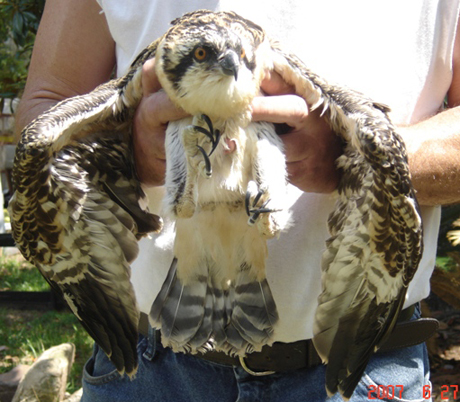
Week Three
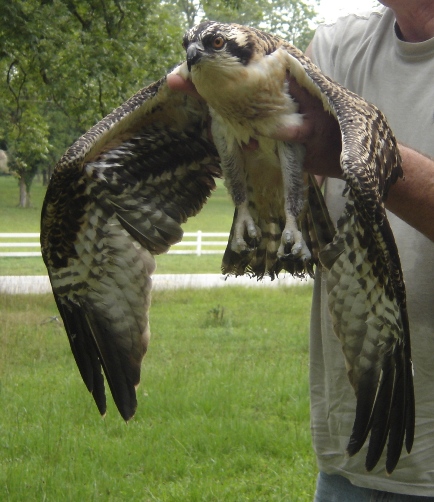
Week Four
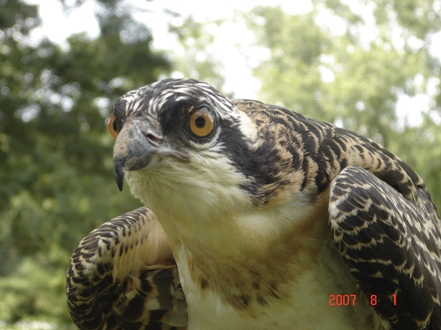
Stoops is full-grown now though flight is not very good yet.
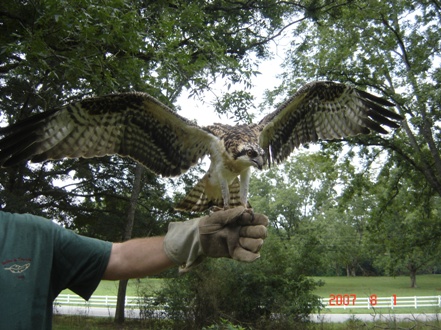
Stoops with outstretched wings.
Weeks 5 and 6
Houston, this is osprey control..... Stoops has achieved liftoff!!
While the headline sounds glamorous, the flight was not. Stoops is making short flights, eight to ten feet, from the ground to a perch and vice versa.
Her weight is now at 3 pounds. She is consuming 3-4 fish daily, each weighing between 1 to 2 pounds. Most remarkable are her feet as she has now grown into them. All of her pin feathers and baby feathers have been replaced with real flying feathers. Best of all, she is demonstrating a healthy aversion to people.
Next week, she will be moving into a huge open air flight pen overlooking a pond. It's her time to learn where fish come from! The pond area is in an undisclosed location to prevent her from making the connection of food to people.
It is against Federal (US Fish and Wildlife Service) regulations and State (Department of Natural Resources) regulations for the public to tour a wildlife rehabilitation facility. We have to respect these regulations because these agencies issue our permits. The goal of rehab is to return the raptors to the wild so it is essential for them to have minimum contact with people.
In the past, we have experienced angry responses from donors who felt that they were entitled to tours because of their financial contibutions. We have held to the standards of the regulations in spite of their dissatisfaction and withdrawal of financial support.
Raptors, eagles, hawks, owls, falcons, and vultures are the most expensive wildlife to rehabilitate. The Feds and the State have adopted standards of size with which compliance is mandatory. Squirrels and songbirds can be rehabilitated in small enclosures for release. The smallest raptor enclosures are 8 feet by 8 feet and it is for the tiny screech owls. All other flight pens increase in size up to 100 feet long by 16 feet wide by 20 feet tall.
The wood used in construction must be untreated to prevent chemical injuries to the raptors. All of our flight pens are hand-treated with a water based preservative. The treatment is necessary to protect the outside of the flight pens from the heat and humidity of Georgia weather.
In 2006, our reports indicate that between January 1st and December 31st, we received 54 raptors into rehab. When this is averaged into the expenses, it comes to about $317.00 per raptor. Since Hurricane Katrina, our donations have dwindled to next to nothing. Why do we continue on? If not me, then who? There is no magical government hope chest at the end of a rainbow.
These raptors are part of our heritage. They are part of the heritage and future of Georgia. They control the rodents and other populations much more effectively than any synthetic chemicals. Most remarkably, they are willing to live with us in spite of our encroachments on their hunting grounds and breeding areas.
This program survives on the donations of regular people like you. If not you, then who?
100% of all donations goes directly into rehab and release. Unlike many 501(c)3 non-profits, we do not use donations for salaries.
PO Box 103
Zebulon, Georgia 30295
[Note from the Editor: I got up close and personal with Stoops and she did not like it at all. She kept turning her back to me on the perch and at the end of her photo session, I got to witness an amazing sight. Stoops had a tailwind that hit her backside just right as she was turning on her perch. She turns by flapping her wings to aid in her balance and just as she was turning around, she took to the air.
Stoops flew 300 yards or so to land in a nearby field. It was obvious that she was stunned by the flight and even walked a couple of steps towards Steve Hicks with a dazed look in her eyes as if to say, "What was that?!" And it was just my luck that she startled us so bad that I didn't get it on film!
Needless to say, there will be no more up close photo sessions where I can take pictures of Stoops staring at her feet and wondering about how they work, but we'll see about getting some film with Stoops learning where fish come from. Stoops really did like to stare at her feet a lot, much like babies who discover that there is something beside their hands to put in their mouths.
Every little bit helps in an organization like this. A $10 check combined with other $10 and $25 checks can help with the rehabilitation of Stoops and other raptors native to Georgia. You can get an up-close experience with these magnificent birds by scheduling a wildlife educational program for a birthday party or other special occasion by calling Steve and Angela Hicks from Bubba and Friends, Inc. at 770-567-1852.]
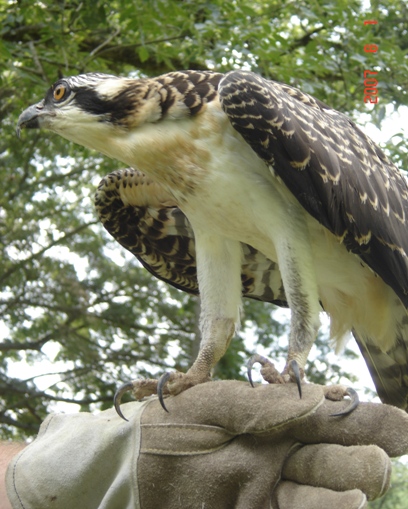
Stoops checks out her surroundings while standing on a glove.
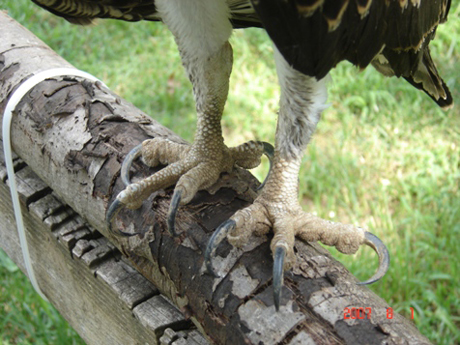
Stoops has cool feet. There are suckers on the bottom of her feet to hold onto the fish when she eventually learns catch fish out of the water.
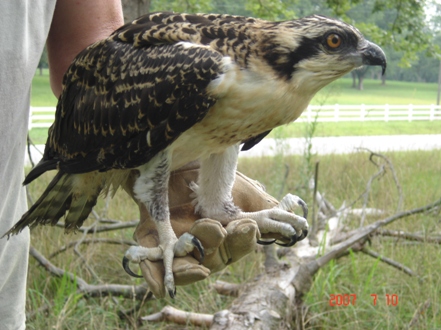
The osprey stands on the ground and dares me to come closer to her. I was too close for comfort as it was. Read the story below to find out her name and why Angie and Steve think this osprey is a female.
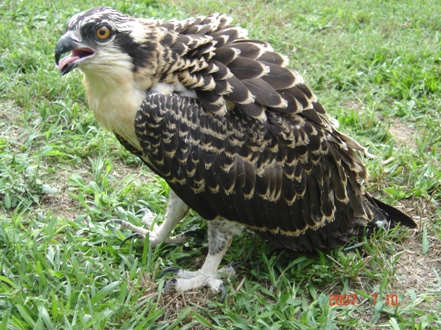
She is almost full-grown. Her baby fuzz is pretty much gone except for that left beneath the feathers on her back. She has filled out nicely, but she is still wild and is not fond of human contact.
Week 4
The orphan osprey continues to astonish all with its growth. Based on its size, we are reasonably sure it is a "she". In the world of birds of prey, females are larger than the males.
After weeks of referring to the osprey as "the orphan", she has finally gotten a name. It is a name that describes some of her juvenile actions, her future flying skill, and is the last name of a big fan of hers: Stoops.
Stoops the osprey stoops down to walk under a perch rather than go over it. In flight, she will go into a stoop (a kind of dive) when she goes after fish. Judy Stoops of Suwannee, Georgia is a big fan. So Stoops it is!
Stoops is currently eating 2-3 fish daily. The fish average 9-10 inches in length. She has yet to start tearing fish on her own. Amazingly she can find a piece of fish dropped in the sticks of the nest and move the sticks around to procure her morsel. Her scream is very shrill and irritating to the human ear. She doesn't know when to use her "inside voice". We all look forward to her voice control as she matures.
Stoops is getting close to that first flight. Solid footing seems more comfortable to her than a leap into the air. If our guess about her age is correct, she should lumber into the sky for short distances at any time. Research indicates osprey young usually take their first flight when they are 58-60 days old. We are close.
Houston, we have countdown for the Stoops launch....
Note from the Editor: Stoops cannot be handled without gloves anymore. She likes to bite at fingers and her talons are long and sharp and perfect for grabbing fish out of the water. She does flap her wings and fall backwards a little, but she is not really into flying yet. That will probably happen during the next week. These pictures were taken on July 10th.
State and federal regulations do not allow public viewing of these animals while they are being rehabilitated. However, Bubba and Friends, Inc. does give educational programs at festivals, at birthday parties or other special events, and at the upcoming Harry Potter event featuring Al the Owl at Barnes and Noble Bookstore on Mt. Zion Road on July 20th. See the article on the home page for the date and time if you want a picture with Al. You can contact Steve and Angela Hicks from Bubba and Friends, Inc. at 770-567-1852 if you are interested in an educational program.
Bubba and Friends, Inc. is a non-profit 501(c)(3) organization whose mission is rehabilitating birds of prey into the wild. The facility is not open for public tours in order to comply with state and federal regulations.
Bubba and Friends, Inc. operates on private donations and receives no state or federal assistance. Donations can be sent to:
P.O. Box 103
Zebulon, Georgia 30295.
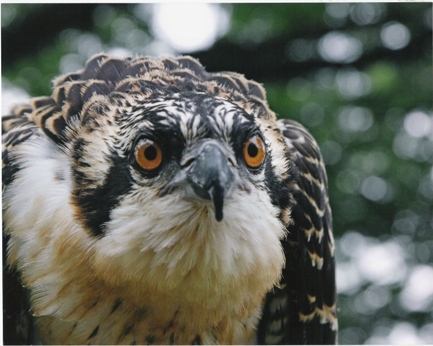
Stoops is magestic. Her feathers are puffed out in this picture as a defensive measure
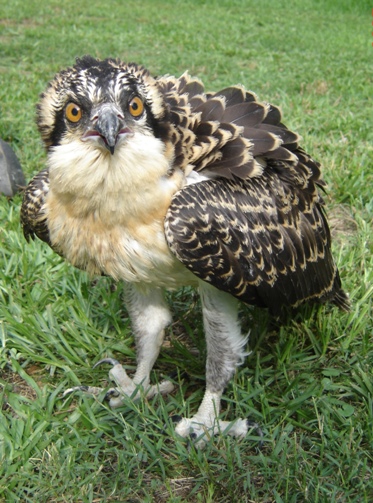
Her growth is evident during the past month as you compare pictures from Week 1 to this picture.
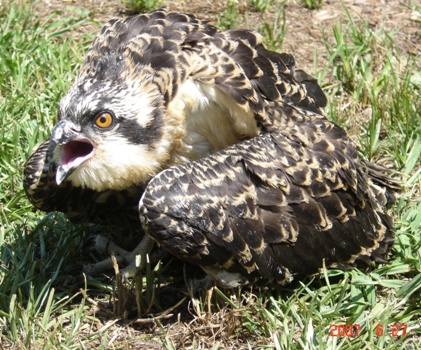
The osprey stands its ground as I take pictures from a short distance away. The feathers are standing up on the back of its head and neck.
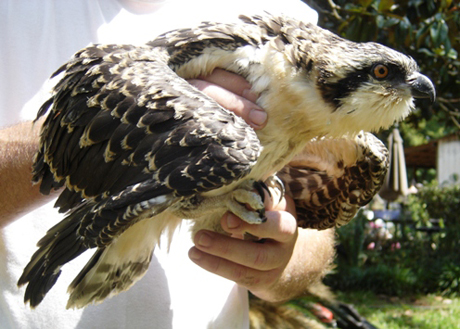
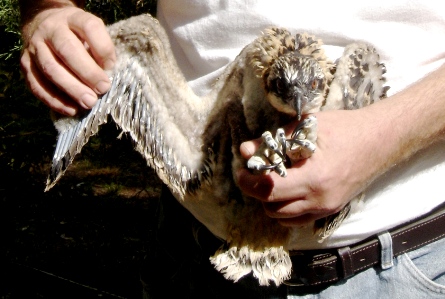
Imagine holding a flapping 2 1/2 pound osprey for part of photo session. It has grown a great deal since the last photo session.
Week 3
It's been another week of ups and downs with the ospreys. The oldest one continues to put on weight and demonstrate rigor on its flight attempts.
On Sunday morning, June 17, the younger of the two remaining ospreys began throwing up up his food. Before intervention could be initiated, he died. A whirlwind of activity followed.
Note were reviewed and discussions revisited. We now have experienced two deaths with unusual circumstances. Over the next two days, we consulted with every resource available. One vet suggested a possible cause of death that all of us had overlooked.
When the nest toppled from the tree, approximately 40 feet up in the air, the impact of the water could have caused internal injuries to soft tissue. These injuries would not have been visible on x-ray. This would explain the sudden onset of problems and rapid demise.
We will continue to work with the remaining osprey until he is released. His wieght is now 2 1/2 pounds.
Bubba and Friends, Inc. is a non-profit 501(c)(3) organization whose mission is rehabilitating birds of prey into the wild. The facility is not open for public tours in order to comply with state and federal regulations.
Bubba and Friends, Inc. operates on private donations and receives no state or federal assistance. Donations can be sent to:
P.O. Box 103
Zebulon, Georgia 30295.
Note from the Editor: This osprey screeched at me during this visit as it has on the previous two visits. It is not fond of human contact and Steve Hicks mentioned that it occasionally goes after fingers as well as the food that is being held out for it.
Human contact with this osprey is being minimized during its rehabilitation so it can be released back into the wild. It tolerates humans because it has to have food. It is easy for me to remember that it is a wild animal and not a pet that can be shown off to others. The talons and beak are vivid reminders that it will eventually be released into the wild.
I have been asked if the public can view these animals at their current location. As the article above states very plainly, the answer to that question is no. State and federal regulations do not allow public viewing of these animals while they are being rehabilitated.
However, Bubba and Friends, Inc. does give educational programs at festivals, at birthday parties or other special events, and at the upcoming Harry Potter event featuring Al the Owl at Barnes and Noble Bookstore on Mt. Zion Road on July 20th. You can contact Steve and Angela Hicks from Bubba and Friends, Inc. at 770-567-1852 if you are interested in an educational program.
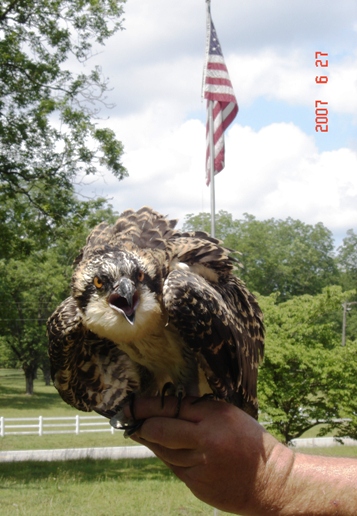
This osprey stands fierce and proud.
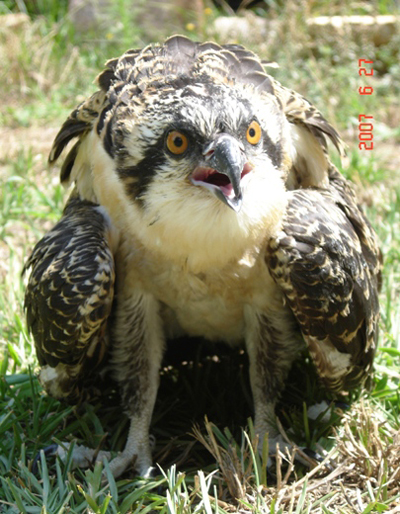
Note that the baby fuzz is gone and feathers are in its place.
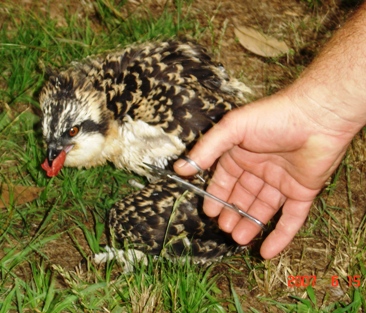
The picture on the left shows this osprey as it eats. It is still being fed with pieces of fish on a pair of forceps. It won't be long until Steve and Angela will be able to toss food to it and it eat on its own.
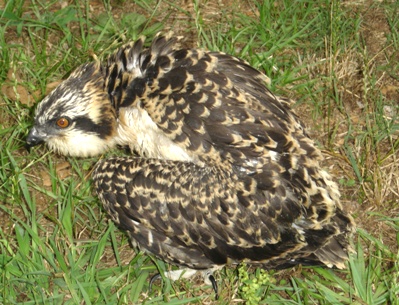
The picture on the right is of the strongest sibling as it walked on the ground. Notice the feathers on the back of its head are standing up--sort of like a dog raising its hackles.
Week 2
The osprey babies currently weigh 24 ounces each (a pound and a half) and yet their size is almost equal to an adult redtail hawk. Appetites are increasing daily. By summer's end, they should achieve their six foot wingspan and glide easily into the big blue.
Ospreys (Pandion Haliaetus) are also known as sea eagles or sea hawks. They are members of the eagle family and subject to the same hazards that affect Golden and Bald Eagles. Ospreys usually lay their three eggs in the nest over a period of days. The delay benefits the parents by reducing the food needed to feed the babies.
Unfortunately, this usually results in the early death of the youngest osprey as the older siblings dominate the food. Incubation time on the eggs is between 28 and 33 days. The young will take flight between 51 and 59 days after hatching.
Flight speed is not as spectacular as the peregrine falcon. Ospreys flight speed will max out around 80 miles per hour. They fly as fast as they need to.
In 1975, a banded (USFWS band) osprey was found dead in Herring Creek, Deleware. The recorded band number indicated that the osprey was 32 years old. Most probably live much shorter lives.
The orphan ospreys are beginning to flex their wings and pay close attention to their environment.
On Thursday, June 14, the orphans and their friends experienced a terrible afternoon. The youngest of the three died. It was truly a shock as the youngest voice in the "clucking" choir went silent.
The remaining two ospreys are under even closer observation for weight loss or other difficulties.
Note from the Editor: I went to visit with Steve and Angela Hicks of Bubba and Friends, Inc. on Friday, June 15, 2007 in order to do an update on the ospreys. The oldest osprey was placed on the ground outside so I could get pictures while it ate and screeched at me. Steve told me that they have to position his pen in a manner that it cannot see them in the house or outside because it screeches to be fed any time that it sees them.
The pictures will show that this baby has grown in its wing feathers and most of its baby fuzz is gone. It is huge at a distance of a foot or so away from me and it did not like me taking pictures of it all. But the public will appreciate its beauty and I hope you will also appreciate the job that Bubba and Friends, Inc. is doing in the rehabilitation of raptors in our area. It is not an easy job to keep this little one fed.
The two remaining ospreys have been placed in separate cages. The oldest one is outside and seems to be doing fine. The middle osprey is inside for observation.
The story from Week 1 is below. It contains contact information for Bubba and Friends, Inc. for contributions as well. We will continue with weekly articles on the ospreys until they are released into the wild.
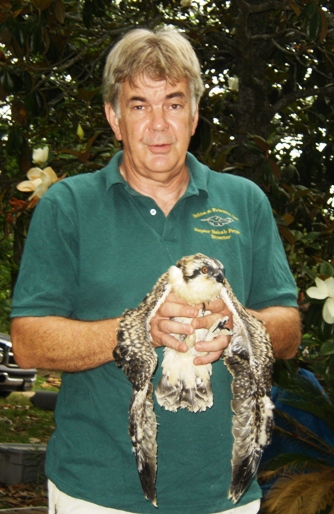
This osprey has grown a great deal since last week. Compare its feathers in this picture to the picture located below the story from last week. Steve had a time holding the bird because it was constantly flapping its wings
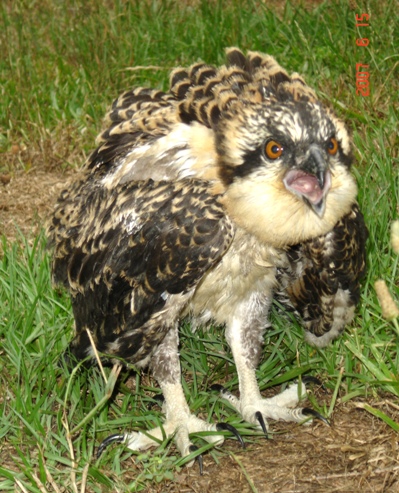 The osprey was pretty fierce as it stood there shrieking at me for taking pictures and wanting to be fed. It cannot fly yet but won't be too long until it can fly. It was somewhat intimidating to take pictures with sharp talons and beak this close. It was a constant reminder that this is a wild creature and not a pet.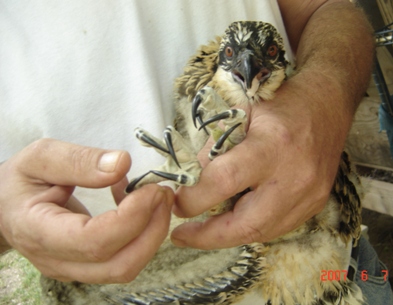
The picture on the left was taken as Steve is hand-feeding one of the weaker siblings. Those talons are sharp and he held them with one hand while feeding this baby osprey.
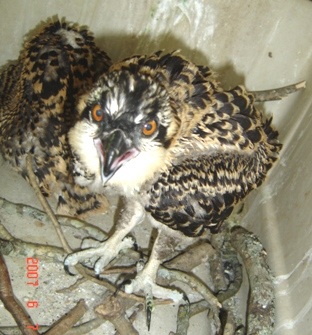
The picture on the right is of the strongest sibling that ate bits of fish from the end of a pair of forceps and shrieked when it wasn't eating.
Three orphan Ospreys arrived in Pike County on June 6, 2007. The babies were recovered from a lake near Lake Sinclair in Central Georgia.
Ospreys are sea eagles and spend their lives around large bodies of water. Usually found on the Georgia coast, they have moved up the rivers into the heart of Georgia. There are nesting pairs on the Flint River in Pike County.
Ospreys build nests year after year in the same tree. Some nests may weigh hundreds or even thousands of pounds. The three orphans were in a tree that died as a result of the weight of the massive nest. A large limb supporting the nest broke and the nest--complete with its passengers--slid, totally intact, into the lake.
Observers on the scene were treated to the sight of frantic parents trying to feed their floating babies. All observing ceased as a large snapping turtle made is way into the floating nest and a rescue was initiated.
The orphans were transported to a veterinarian in Milledgeville to be checked out for injuries. After their exam, they were transported en masse to Bubba and Friends, Inc. near Zebulon, Georgia. Bubba and Friends is the only raptor rehabilitation facility with people capable of handling eagles in central Georgia.
Orphan ospreys have voracious appetites and consume large amounts of food. Fully grown, the wingspan will reach approximately six feet from wingtip to wingtip.
Bubba and Friends, Inc. is a non-profit 501(c)(3) organization whose mission is rehabilitating birds of prey into the wild. The facility is not open for public tours in order to comply with state and federal regulations.
Bubba and Friends, Inc. operates on private donations and receives no state or federal assistance. Donations can be sent to:
P.O. Box 103
Zebulon, Georgia 30295.
Note from the Editor: I interviewed Steve Hicks and took pictures of the ospreys on the day after they arrived in Pike County. On their fourth feeding of the day, only one of the ospreys was eating without help. "It is pretty incredible that all three babies survived the fall," Steve said. Nests are normally 30 or 40 feet up in the air and composed of tree limbs.
Steve had to feed the strongest osprey with bits of fish from a pair of forceps. They other two had to be hand fed. In a real life situation, one or more of the weaker offspring would probably have been pushed from the nest so the stronger osprey could receive more food from the parents.
The strongest of the three ospreys looked pretty menacing as I took pictures. With talons as long as my little finger and a sharp beak that emitted piercing shrieks to be fed, I let Steve do his work and only got as close as I had to. The only time this baby was quiet was when it was eating bits of fish. You can see that the osprey did not appreciate the flash of my camera from the pictures.
Look at the pictures and you can see that these babies still have baby fuzz with some feathers that have grown in. If the three were spread wingtip to wingtip, they would probably stand higher than 6 feet tall. Steve told me that when they get big enough to release into the wild, they will have role models to follow in our area.
If anyone would like to donate some fresh fish to Steve and Angela for the ospreys, give them a call at 770-567-1852. These babies will need a 100 foot flight pen so donations would be appreciated in that endeavor. The flight pen will cost over $5,000 because of the special materials that are needed for the birds.
Bubba and Friends is the same group that just gave a program at the library for the summer reading kickoff. I will provide weekly updates and pictures of the ospreys as they grow and eventually are released into the wild.
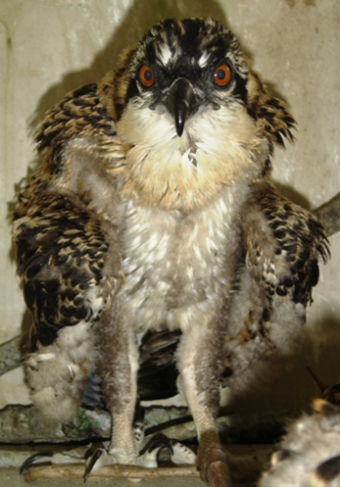
This osprey's feathers stand out from the fuzz on its body.
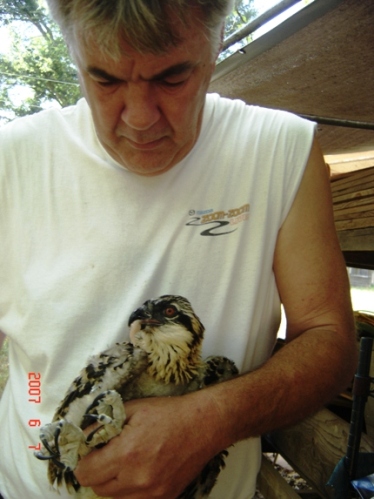
Steve holds the osprey's talons while it eats a bit of fish